
Ask a chatbot to build you a portfolio and it will. No licence, no suitability assessment, no record of the conversation, no one to complain to. Ask a portfolio manager whether AI has changed how they work and you get a longer answer about data pipelines, model validation, and who signs off on a trade.
Both are AI in investing. They are not the same activity, and most of the current confusion sits between them.
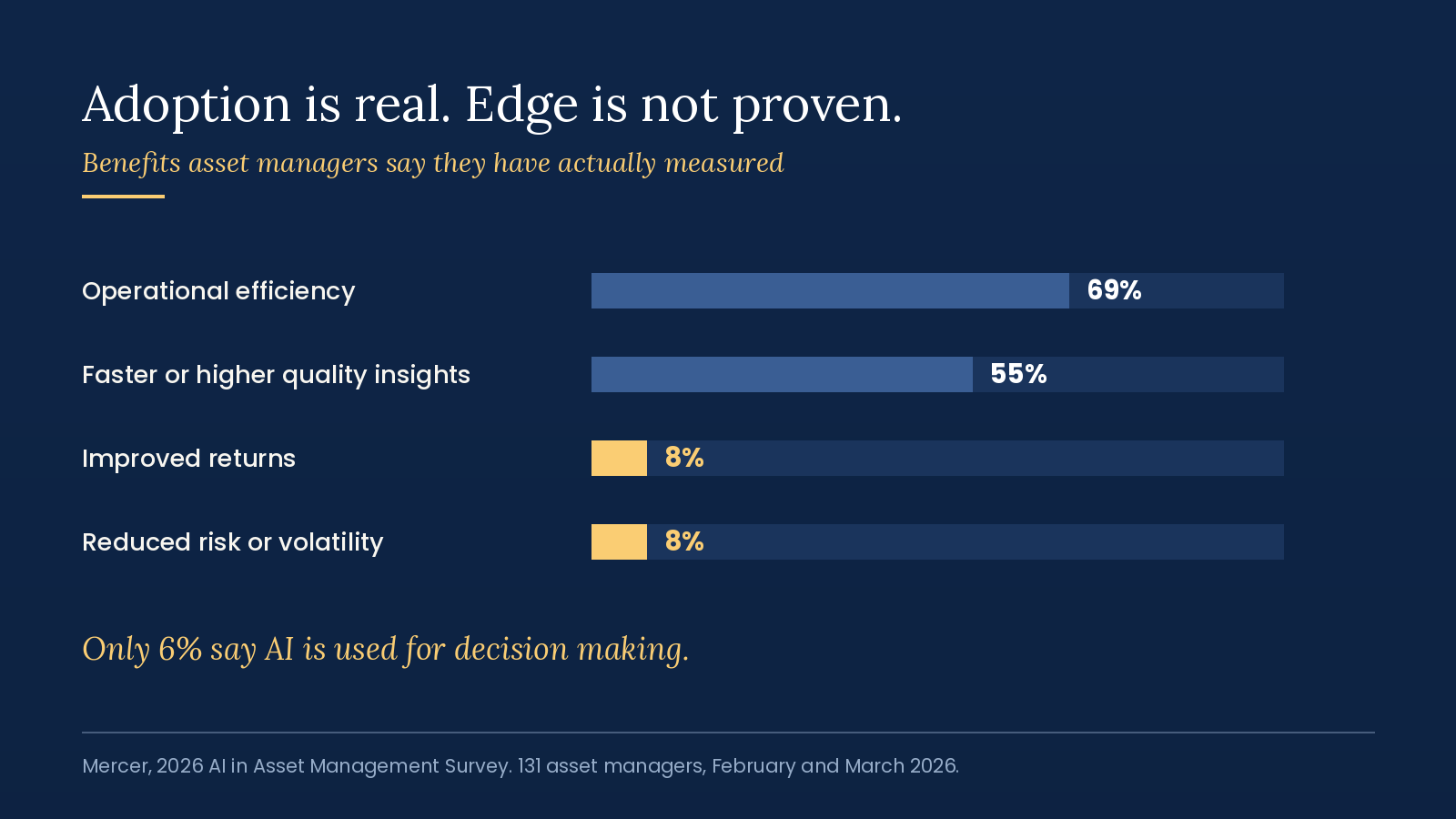
Adoption is real. Edge is not proven.
Mercer surveyed 131 asset managers globally in February and March 2026. Some 55% have integrated AI into at least one investment process, 27% are running pilots, 18% have nothing in production, and 91% plan to increase use over the next twelve months.
Asked which benefits they had measured, 69% cited operational efficiency and 55% cited faster or higher quality insights. Improved returns and reduced risk were each cited by 8%.
Asked what AI is inside their firm, 74% describe it as operational, meaning automation and efficiency, and 69% as a co-pilot, meaning insight and analysis. Only 6% say it is used for decision making.
The barriers cited most often are data quality and access (69%) and regulatory or compliance concerns (59%).
SimCorp's 2026 InvestOps report, covering 200 senior executives at firms managing at least USD 10 billion, puts front office AI use at around 70%, up from roughly one in ten a year earlier. The gap between that figure and Mercer's is definitional. “Used somewhere in the front office” is a different claim from “integrated into the investment process with attributable return impact.”
AI is delivering efficiency, not alpha. Compressing the time between a question and the evidence to answer it has real value in a research function. It is still a different claim from “our AI improves returns,” and the two are routinely sold as one.
Where the deployments actually sit
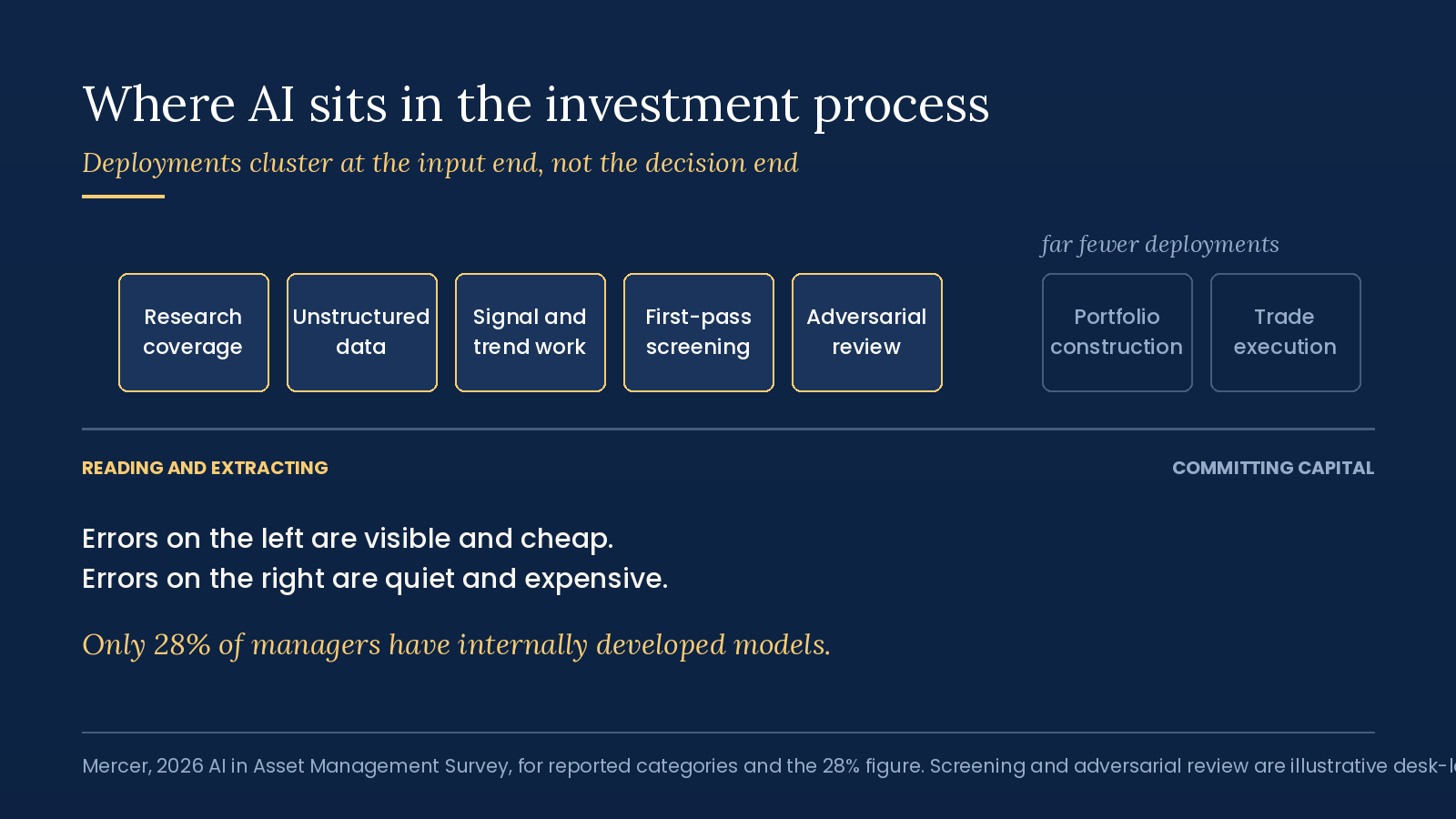
The live use cases cluster at one end of the process. The categories most commonly reported as already integrated are idea generation and research, processing unstructured and external datasets, and signal generation and market trend analysis. Far fewer managers report AI embedded in portfolio construction or trade execution.
AI has been adopted where the work is reading, extracting and searching. It has not been adopted where the work is committing capital. Errors in the first category are visible and cheap. Errors in the second are quiet and expensive.
Research coverage. Reading earnings call transcripts across a peer set and flagging what changed in management's language since the previous quarter. Pulling comparable line items out of filings that were never standardised. Widening the number of names an analyst can cover without adding headcount.
Unstructured data. Turning filings, disclosures, news flow and regulatory publications into something queryable. The least glamorous category and the one with the clearest return.
Signal and trend work. Sentiment extraction, thematic clustering, tracking how a narrative moves through coverage. Useful as an input, dangerous as a trigger.
First-pass screening. Narrowing a manager universe, a deal pipeline or a watchlist before a human looks properly. The model reduces the set. It does not choose from it.
Adversarial review. Hand the model your investment memo and ask it to build the strongest argument against the position. It is better at attacking a thesis than originating one, and it has no stake in the answer.
Control functions. Alert triage in AML and sanctions screening, adverse media checks, regulatory change tracking, first drafts of client reporting. Each with a human decision point at the end.
For anyone running diligence, one further number: only 28% of managers have internally developed AI models. The majority are consuming vendor capability, so the governance question extends to the vendor, the model underneath, and what happens when either changes.
What a chatbot hands an untrained investor
A new NBER working paper by Bruce Carlin (Rice), Ryan Israelsen (Michigan State) and Christopher Wazzan (Berkeley) is the best evidence available on this.
Rather than backtesting, which risks testing a model on data it was trained on, the authors ran the experiment forward. From August 2025 to April 2026 they submitted daily prompts to ChatGPT 5.0 and 5.2, Claude Sonnet 4.5, Gemini 2.5 Flash and Grok 4.1 Fast, asking for portfolios designed to beat the S&P 500. The prompts were deliberately ordinary, the kind a household would type. The dataset runs to more than 1,200 portfolio-day observations.
The output was consistent.
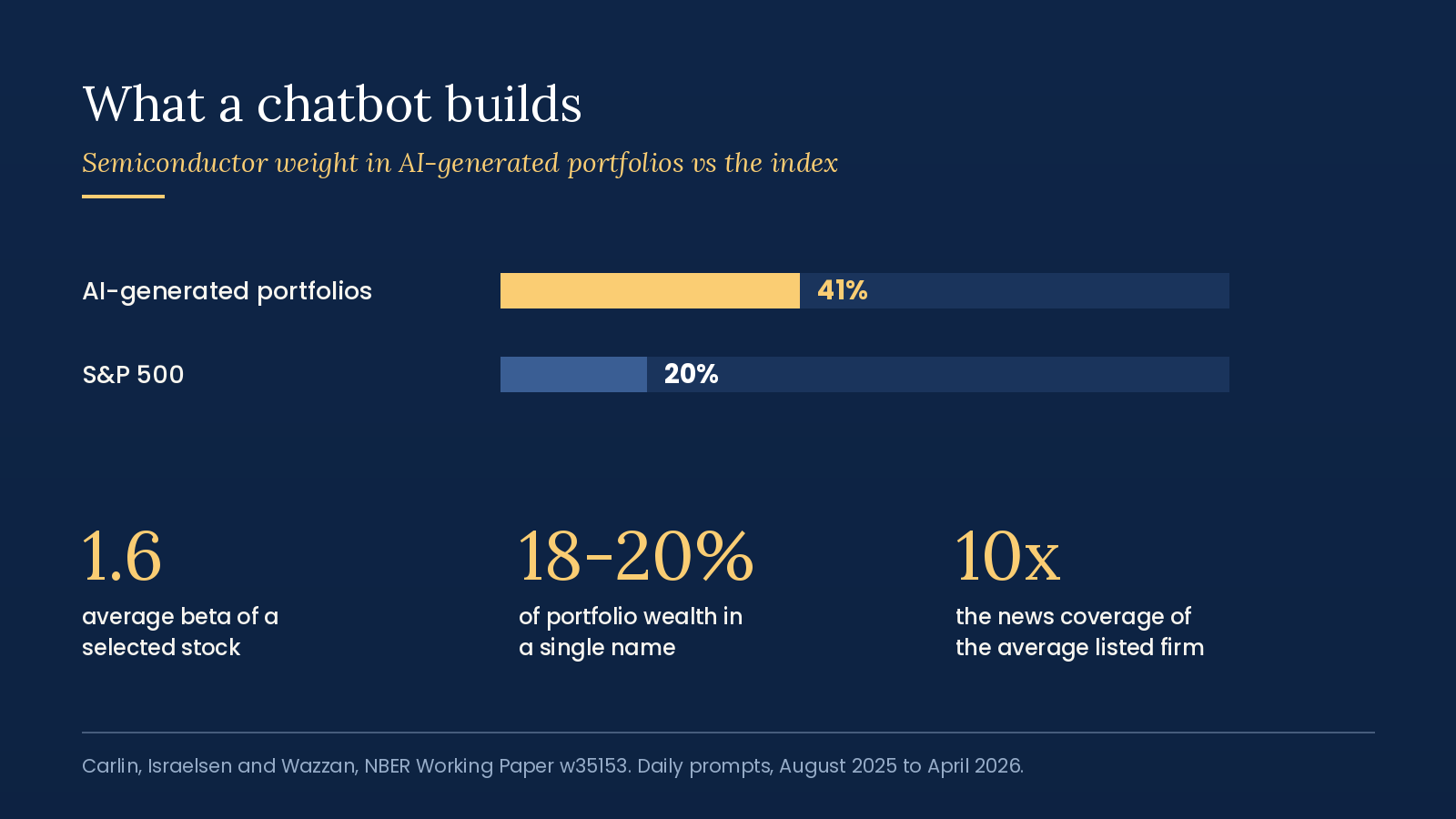
Concentration. ChatGPT 5.0 held roughly 18 to 19 names, Gemini a median of 4.5. ChatGPT put 18% to 20% of portfolio wealth into Nvidia alone across the whole sample, and concentration increased over time.
Sector distortion. Semiconductors averaged 41% of AI portfolios against roughly 20% of the S&P 500. Banks and financial firms, around 10% of the index, did not appear in ChatGPT's top seven industries.
Risk appetite. The average beta of a selected stock was about 1.6. Instructed to hold portfolio beta between 0.9 and 1.1, one version hugged the upper bound and occasionally broke through it.
Salience over analysis. Selected stocks received roughly ten times as many news articles as the average listed firm.
On raw numbers the portfolios looked good, running ahead of the index with higher Sharpe ratios in most specifications. The authors then benchmarked each holding against peer stocks matched on size, book-to-market and momentum, using the Daniel, Grinblatt, Titman and Wermers approach. Most of the outperformance did not survive. Excess returns were largely statistically insignificant once the tilts were accounted for.
The return came from factor exposures any investor can buy cheaply and deliberately, delivered here without disclosure, without sizing discipline, and in the register of advice.
Caveats: the sample for three of the four models is short, it covers an unusually strong market, and it tests naive prompting rather than skilled use.
Against that, usage. eToro's survey of 11,000 retail investors globally found 13% already using chatbots for stock selection and around half open to it. An Investing.com poll of 938 US investors in March 2026 put AI use in investment decisions at 62%, with general-purpose chatbots the most common tool.
A large and growing group is taking portfolio construction input from a system that reliably produces a concentrated, high-beta, news-weighted equity book.
The individual version of the same discipline
The cases that work sit before the decision rather than at it.
Comprehension. Explaining a fund structure, an expense ratio, a rights issue, a section of a prospectus you did not follow. The cost of an error here is that you ask a second question.
Preparation. Generating the questions to ask about a company or a product, then answering them yourself from primary documents. The model produces the checklist. You produce the verdict.
Document handling. Summarising a factsheet, annual report or term sheet that you then check against the source. Verification is the job, not the final step.
Counter-argument. Asking for the strongest case against a position you already hold and intend to keep.
What belongs off the list: naming the security, setting the weight, timing the entry. Those are the three functions the research found to be concentrated, momentum-chasing and driven by news volume, and the three that determine your outcome.
Regulators have already chosen their framing
The US precedent required no new law. In March 2024 the SEC charged two advisers, Delphia and Global Predictions, over misleading statements about their use of AI. Both settled. The Commission's fiscal 2026 examination priorities keep “AI washing” in scope, with examiners assessing whether marketing materials, Form ADV disclosures and client communications describe the extent and limits of AI use accurately, and whether AI governance policies are followed rather than merely written.
An AI claim is a disclosure, and it will be tested against what the system does.
The GCC has moved along the same line. The Central Bank of the UAE issued a guidance note on 23 February 2026 covering consumer protection and the responsible adoption of AI and machine learning by licensed financial institutions, built around governance and accountability, fairness and non-discrimination, transparency and explainability, and human oversight. Qatar Central Bank has issued AI guidelines for financial institutions under its financial sector and fintech strategies. Bahrain has adopted the GCC guiding manual on AI ethics through the Information and eGovernment Authority alongside its national AI policy framework.
None of these creates a separate legal regime. Each extends existing conduct, governance and model risk expectations to cover AI, which means the obligations already apply.
Why the retail question is sharper here
BCG's Global Asset Management Report 2026 puts GCC assets under management at USD 2.7 trillion, with institutional capital at 93% of the regional total. Retail AuM grew 14% in 2025 against 9% for institutional assets.
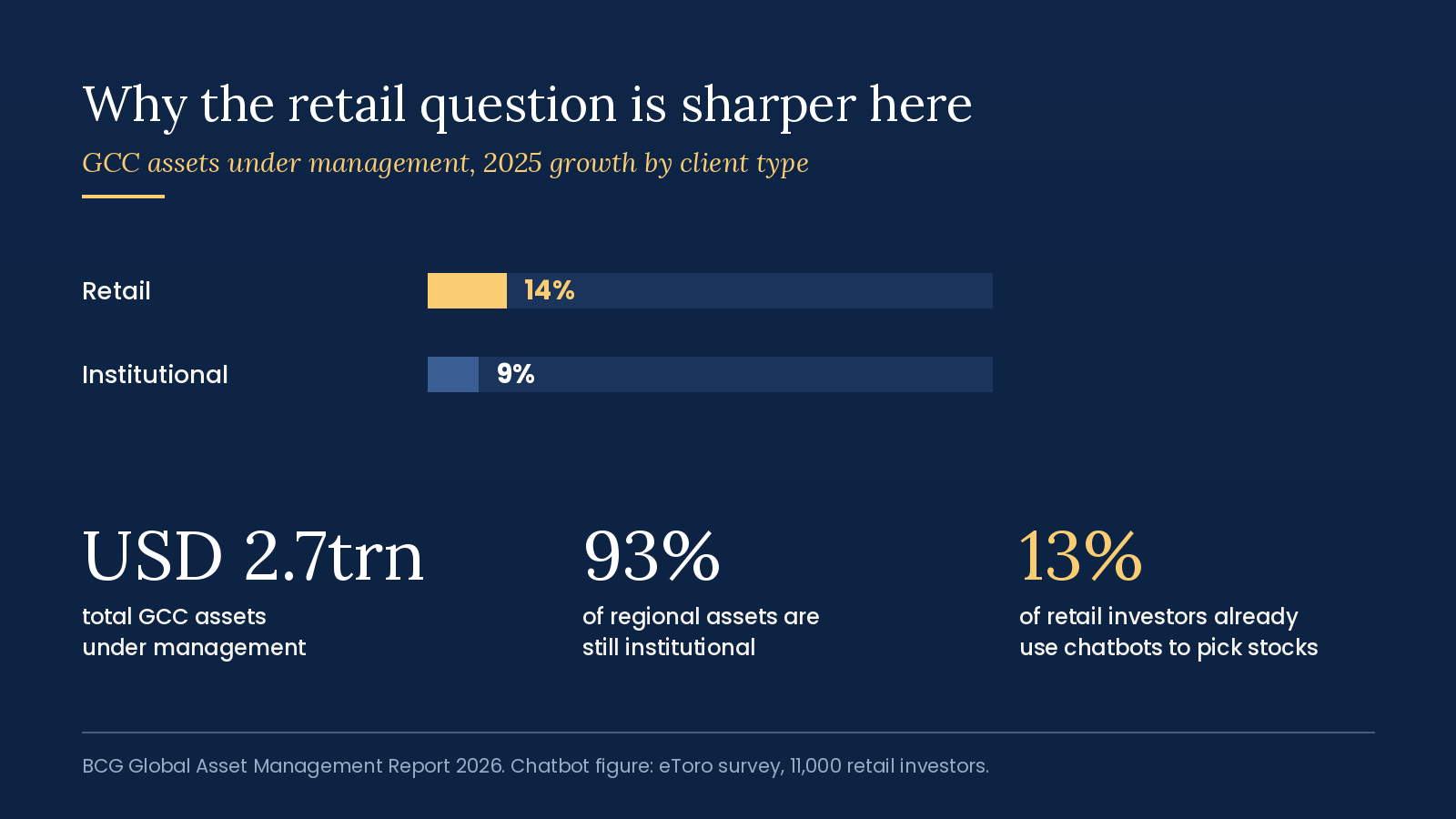
Add a young, mobile-first population, rising participation in regional markets, and an expanding set of low-friction platforms. That is the environment in which chatbot portfolio advice spreads fastest, and the population for which concentration does the most damage. A first-time investor holding four semiconductor names is carrying idiosyncratic risk nobody disclosed, in a currency and a market they may never have considered.
Two obligations follow for institutions in the region. The internal one is knowing what your own models are permitted to decide, and being able to evidence it. The external one is knowing what your clients are already doing without you.
A working test
For an allocator assessing a manager, a compliance officer reviewing a pitch, or an individual assessing their own process, four questions do most of the work:
- What is in production, and what is still a pilot?
- What does the model decide, and what does it only retrieve?
- Who validates the output, how often, and against what?
- If the AI claim were deleted from the pitch, what would change about the strategy?
The fourth separates capability from theatre. Where the answer is “nothing,” the AI was decoration, and describing it otherwise is now a disclosure risk in at least three jurisdictions.
Sources
- Mercer, How Artificial Intelligence is Shaping Asset Management, 2026 AI in Asset Management Survey (131 managers, February and March 2026)
- SimCorp, 2026 InvestOps Report (200 executives, firms with USD 10bn+ AUM)
- Carlin, Israelsen and Wazzan, NBER Working Paper w35153 (nber.org/papers/w35153)
- SEC Division of Examinations, Fiscal Year 2026 Examination Priorities; SEC enforcement actions against Delphia and Global Predictions, March 2024
- Central Bank of the UAE, Guidance Note on Consumer Protection and Responsible Adoption and Use of Artificial Intelligence and Machine Learning by Licensed Financial Institutions, 23 February 2026 (rulebook.centralbank.ae)
- BCG, Global Asset Management Report 2026
- eToro retail investor survey (11,000 respondents); Investing.com retail investor survey (938 respondents, March 2026)
Talal Ramadhan writes on financial regulation and fintech infrastructure in the GCC. Views are his own.
The views in this article are my own and do not represent the position of any organisation I am affiliated with.